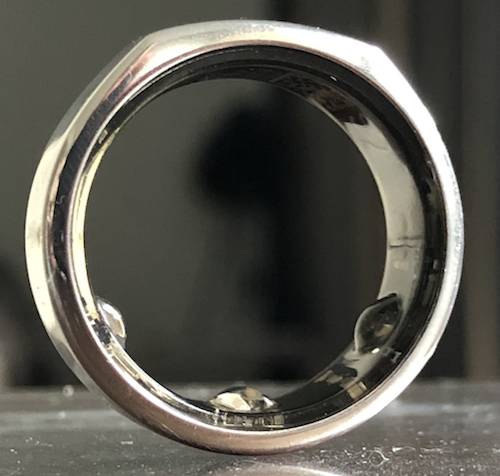
The inside of an Oura Ring 5, Oura’s newest ring since May 2026, holds green, red and infrared LEDs, a digital temperature sensor and an accelerometer. A smart ring shines light into your finger, reads the temperature of your skin and records how your hand moves. Sleep stages, readiness scores, stress levels, cycle predictions and blood pressure patterns have no sensor of their own. Software in the app calculates them from those three signals.
The other major smart rings are built the same way. The Samsung Galaxy Ring has three sensors: an optical bio-signal sensor, a skin temperature sensor and an accelerometer. The RingConn Gen 3 has an optical heart rate sensor, a temperature sensor and a 3-axis accelerometer, plus a vibration motor that sends alerts but measures nothing. The Ultrahuman Ring PRO lists temperature, PPG and a 6-axis motion sensor.
Light on the finger gives heart rate, HRV and blood oxygen
Most of the work is done by light. Each heartbeat pushes a small wave of blood through the vessels in your finger, and the amount of light that bounces back to a detector rises and falls with it. The technique is called photoplethysmography, usually shortened to PPG. The timing of those pulses gives your heart rate, and the tiny shifts in time between one beat and the next give your heart rate variability, or HRV.
On the Oura Ring 5, as on the Ring 4, green and infrared LEDs take turns to measure heart rate, HRV and respiration rate, while red and infrared LEDs measure blood oxygen. Blood rich in oxygen and blood low in oxygen absorb red and infrared light in different proportions, and comparing the two gives an estimate of oxygen saturation. That estimate is sensitive to fit, cold fingers and movement, which is why wearable SpO2 is best read as an overnight trend rather than as a single number.
The temperature sensor reads skin, not the core temperature a doctor would take. Rings report it as a deviation from your own baseline, a little above or below your normal, rather than as a fixed figure. The accelerometer counts steps, notices when you start walking or running and tells the software whether you are lying still.
Sleep stages and readiness scores are calculated, not measured
A sleep lab sorts the night into light, deep and REM sleep by recording brain waves. A ring has no way to read brain activity. It combines movement, heart rate, HRV and skin temperature, and a model estimates which stage you were most likely in at each point of the night. Rings are good at telling how long you slept and weaker at splitting that time into exact sleep stages, which is why the deep and REM figures move around from night to night.
The morning score works the same way. Resting heart rate, HRV, sleep and, on some rings, temperature are blended into a single readiness score, which Oura calls Readiness and Samsung calls Energy Score. The makers do not publish their formulas, so the number is one company’s judgment built on top of the signals.
Cycle tracking uses the temperature sensor. After ovulation the hormone progesterone lifts resting body temperature slightly, and a ring worn at night picks up that rise against your baseline. The ring therefore confirms that ovulation has probably happened rather than predicting the exact day, and its cycle predictions improve as it learns your pattern.
A measured signal, such as overnight heart rate, is only as good as the sensor and the fit. An inferred number carries every error in those signals plus the guess made by the model.
Blood pressure on a ring is an overnight trend, not a cuff reading
Oura added Blood Pressure Signals in June 2026 for members in the United States, India and the United Arab Emirates. The feature tracks blood pressure patterns during sleep, and a part of the feature called Nighttime BP examines “your overnight dips for long-term trends.” The app alerts members when their biometrics suggest signs of increasing blood pressure, and members can log readings from a cuff alongside the trend. Oura states that its ring “is not a medical device and is not intended to diagnose, treat, cure, monitor, or prevent medical conditions or illnesses.”
RingConn stops short of blood pressure and offers what it calls vascular health trends. To its own question of whether the Gen 3 measures blood pressure, RingConn answers: “Gen 3 provides vascular health trend insights, not single readings.”
Whoop, which makes a band rather than a ring, sells Daily Blood Pressure Insights and describes the feature as not a medical device. In July 2025 the FDA sent the company a warning letter over its Blood Pressure Insights feature, stating that “FDA has not authorized BPI for any use, including for the measurement or estimation of a user’s blood pressure.” In January 2026 the agency revised its general wellness policy. Under the new version, a wearable that uses optical sensing to estimate blood pressure can count as a wellness product, but only if its values are validated and it is not intended to diagnose or replace an FDA-authorized device. A product meant to monitor or manage a condition such as high blood pressure is a medical device, not a wellness gadget.
Blood sugar is a separate matter. In February 2024 the FDA warned against smartwatches and smart rings that claim to measure blood glucose without piercing the skin. The agency said it had not authorized, cleared or approved any smartwatch or smart ring intended to measure or estimate blood glucose on its own. None of the four rings above lists glucose among its sensors. Ultrahuman sells glucose tracking, but through a separate continuous glucose monitor, the M1, rather than through the ring. Oura does the same with Dexcom’s Stelo glucose biosensor.
FDA clearance covers a named product for a stated use
Most of what a smart ring reports, from sleep and recovery to activity and temperature trends, falls under general wellness. The FDA does not intend to examine low-risk wellness products against the premarket rules for medical devices. A cleared or authorized feature is different: the FDA has reviewed one specific function for one specific use. That decision covers a named product for a stated use, and the other features on the same device stay outside it. A ring can itself be the cleared device: the Evie Med Ring was cleared as an oximeter in November 2024. In the examples below, the cleared products are an app and a watch feature rather than a ring.
Natural Cycles is a birth control app cleared by the FDA as stand-alone software for preventing or planning a pregnancy, and a 2021 clearance added the Oura Ring as an automatic source of temperature for its algorithm, followed by the Apple Watch in 2023. The cleared product is the app. The clearance does not turn the ring’s own cycle predictions into contraception.
In February 2024 the FDA granted De Novo authorization to Samsung’s Sleep Apnea Feature. The feature runs on a compatible Galaxy Watch and phone and looks for signs of moderate to severe obstructive sleep apnea in users 22 and older who have not been diagnosed. The Galaxy Ring is a different product, and its page states that its heart rate software functions are not intended for use in the diagnosis of disease. RingConn, for its part, offers sleep apnea pattern insights on the Gen 3 while stating that the ring is not a medical device.
Two devices can therefore show similar overnight charts while only one feature on one of them carries an FDA decision behind it. An FDA decision covers a named product for a stated use, and nothing else that runs on the same hardware.
A smart ring is best at slow trends in your own body
A smart ring is a good overnight instrument with a narrow job. It sees your pulse, your skin temperature and your stillness for hours while you sleep, and it is at its best when it compares tonight with your own last few weeks. Resting heart rate creeping up, HRV sliding down for several days or a temperature rise that does not fit your cycle are the patterns it catches well.
It is weaker at anything that needs a single precise number. Oura’s blood pressure signals follow overnight patterns, with cuff readings logged alongside them, and none of the four rings lists a glucose sensor. When a number has to support a decision about a medical condition, that job belongs to a device or feature the FDA has reviewed for exactly that use.
Last fact-checked: 14 October 2026